
Charlton County Civil Docket Searches
Superior and State civil cases begin with the official Georgia E-Access directory, where you pick the Charlton court that received the filing. Both routes end at PeachCourt. Registering costs nothing, though an account is required and some document images carry fees. Have the exact case number or a party name ready. Picking the right county is only half the job; the court selector must match too.
- Identify Superior, State, Magistrate, or Probate from the filed form, notice, receipt, or subject matter.
- For Superior or State, enter PeachCourt through Georgia E-Access and select Charlton County plus the correct court.
- Use the exact number with all hyphens and zeroes, or use the party-name route as a backup.
- Open the case and read the filing, service, answer, motion, setting, order, and judgment events in date order.
- For Magistrate or Probate, call Suite B and request inspection or copies because no public online case index was located.
For Superior or State questions, the Suite A clerk takes calls at 912-496-2354. The combined Probate and Magistrate office handles limited civil and probate questions at 912-496-2230.
Charlton Civil Courts Split the Work
No single Charlton County civil court docket holds every civil matter. Superior Court takes divorce, title-to-land, equity, and major civil work. State Court hears the civil actions within its jurisdiction that Superior does not reserve. Magistrate Court covers claims of $15,000 or less. Dispossessories, garnishments, interrogatories, and related post-judgment work land there too. Probate matters stay with the combined Probate and Magistrate office. Access to those records can depend on the case type.
| Matter | Likely docket | Public route |
|---|---|---|
| Divorce, title, equity, major civil | Superior Court | PeachCourt and Suite A |
| Other State civil action | State Court | PeachCourt and Suite A |
| Claim up to $15,000 | Magistrate Court | Suite B and CI- form route |
| Dispossessory, garnishment, Fi-Fa | Magistrate Court | Suite B forms and fee schedule |
| Estate or guardianship | Probate Court | Suite B, subject to access rules |
What guides the choice is the subject, the amount, and the filing form. A party's county address alone does not select the court.
Civil Dockets: What They Show
A Charlton County civil docket opens with a header and the initiating complaint or petition. From there the entries can track service, an answer, discovery, motions, settings, rulings, judgment, collection steps, and appeal. The status field helps. Still, the latest signed order gives firmer meaning to a dismissal, default, or final result.
| Header | Court, case number, filing date, case type, judge, and status. |
|---|---|
| Parties | Plaintiff or petitioner, defendant or respondent, and attorneys of record. |
| Claim | Cause of action, claimed amount, service, and any counterclaim shown. |
| Filings | Complaint, answer, motion, response, exhibit, and signed order dates. |
| Settings | Hearing type, date, time, room, trial, or conference information. |
| Resolution | Judgment, default, dismissal, agreed result, payment, or appeal entry. |
An entry and its document are two different things. A visible filing title does not guarantee the image is online, free, or open.
Charlton CI Cases Start in Suite B
The Probate/Magistrate Court office page describes the combined office and its local civil role.
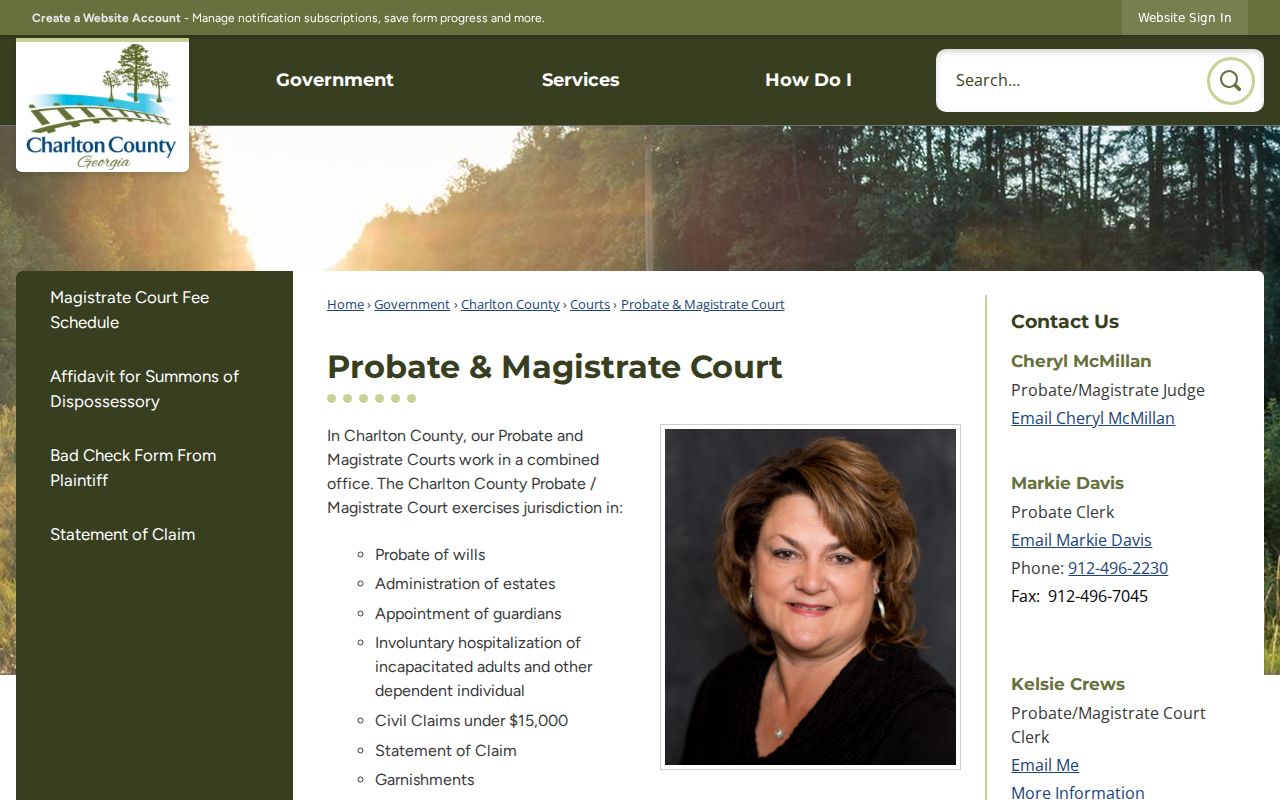
This office works out of Suite B at 1520 Third Street, Folkston. Its records sit apart from the Suite A Superior and State files. Even so, both counters share the courthouse. Official forms here carry the prefix CI-. That prefix is a useful clue for routing a limited civil matter, though the clerk assigns the rest of the number. The county publishes no codebook and no online Magistrate docket viewer. Call the office with the form, filing date, and party details. Then ask how to inspect the docket or get the filed paper.
What Cases Fill the Civil Docket
Charlton County civil court dockets cover several forms of relief, and the court with power to hear the claim matters as much as the claim's label. Major property and domestic matters run through Superior Court. State Court takes civil actions when they fit its jurisdiction. Limited claims, plus several collection or possession proceedings, begin at the Magistrate counter.
- Contract, account, note, and other money claims.
- Divorce, domestic relations, title-to-land, and equity matters.
- Claims of $15,000 or less filed in Magistrate Court.
- Dispossessory, garnishment, interrogatory, and Fi-Fa proceedings.
- Estate and guardianship files held by Probate Court, with case-specific access limits.
A Fi-Fa is Georgia's tool for enforcing a judgment. Filed after judgment, it authorizes collection on what the civil docket shows as owed, though it does not prove the full amount still remains due.
Charlton Statement of Claim Fields
The clearest public sample of where a limited civil case starts is the county's Statement of Claim form, which lays out the fields a filer completes for a Charlton County civil docket entry.
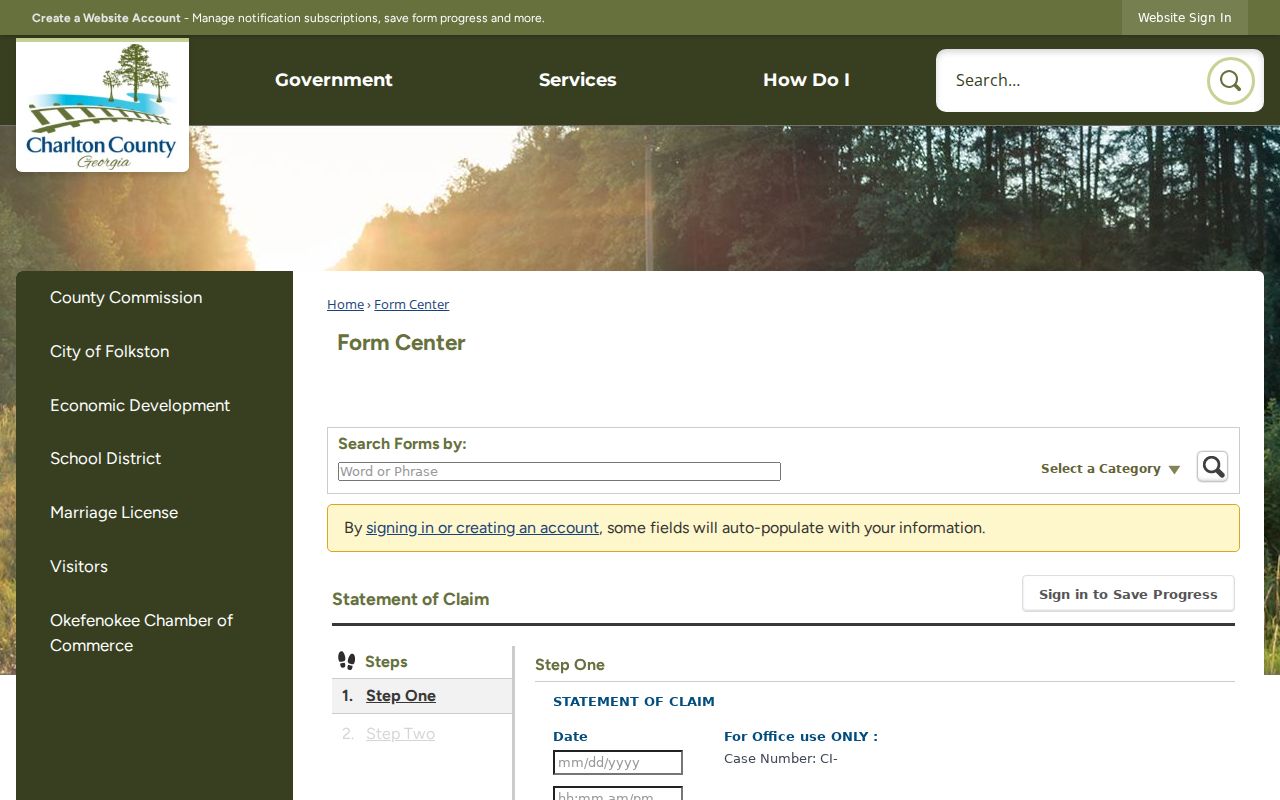
The form shows the office-use CI- number, plaintiff and defendant address fields, action choices, an active-duty question, claim and charge amounts, and a claim narrative. Signing happens before the clerk or a notary. Keep in mind what the blank form is not. It is no docket sheet, and it proves nothing about service, liability, or judgment. The summons allows 30 days to answer. It says the answer may be oral or written at the office during its stated answer hours. A hearing follows once an answer is in. That sequence is why filing, answer, and hearing appear as separate Charlton County civil docket events.
Hearings on the Civil Docket
A setting entry should name the event and the date. It might involve a motion, conference, trial, or another hearing type. A notice or scheduling order often controls details the short docket line omits. A continued matter leaves old dates in the history. Rely on the newest order or confirm the active date with the clerk. Magistrate timing has its own rules. The Statement of Claim allows a 30-day answer period. The official dispossessory summons states a seven-day answer period after service. Different case types, different clocks; the two periods must not be swapped. A missed answer can push a case toward default, but default is a docket stage. The signed judgment controls what relief was actually granted. Note: A blank county form states the process that starts a case. Only the filed docket and orders show what occurred in a specific matter.
Charlton Dispossessory Docket Timing
The official dispossessory affidavit and summons shows the local fields and answer instruction.
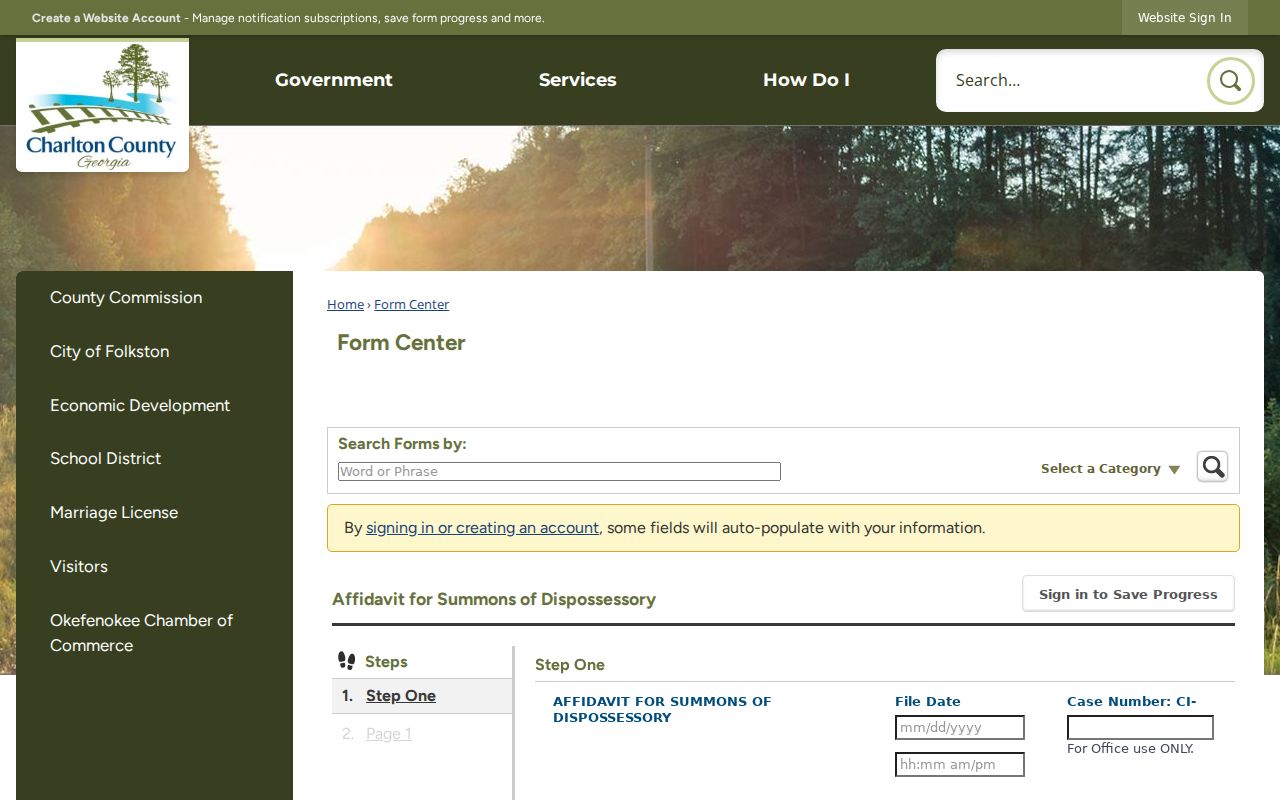
An affidavit for possession carries a CI- number. It also lists the date, party addresses, and a rent-due or holdover choice. The amounts sought cover possession, rent, costs, and damages. The summons gives the tenant seven days from service to answer. None of this settles anything. Those fields state what the landlord asked for, not what the court decided.
Treat each step as its own entry. Service, answer, hearing, and judgment all appear separately on the docket. A dollar figure in the affidavit stays an allegation until the court rules. Later entries may show dismissal, an agreement, a default, a writ, or payment. Some other outcome can appear as well.
Charlton Magistrate Forms and Records
The county's Probate/Magistrate forms index collects the published limited civil starting points.
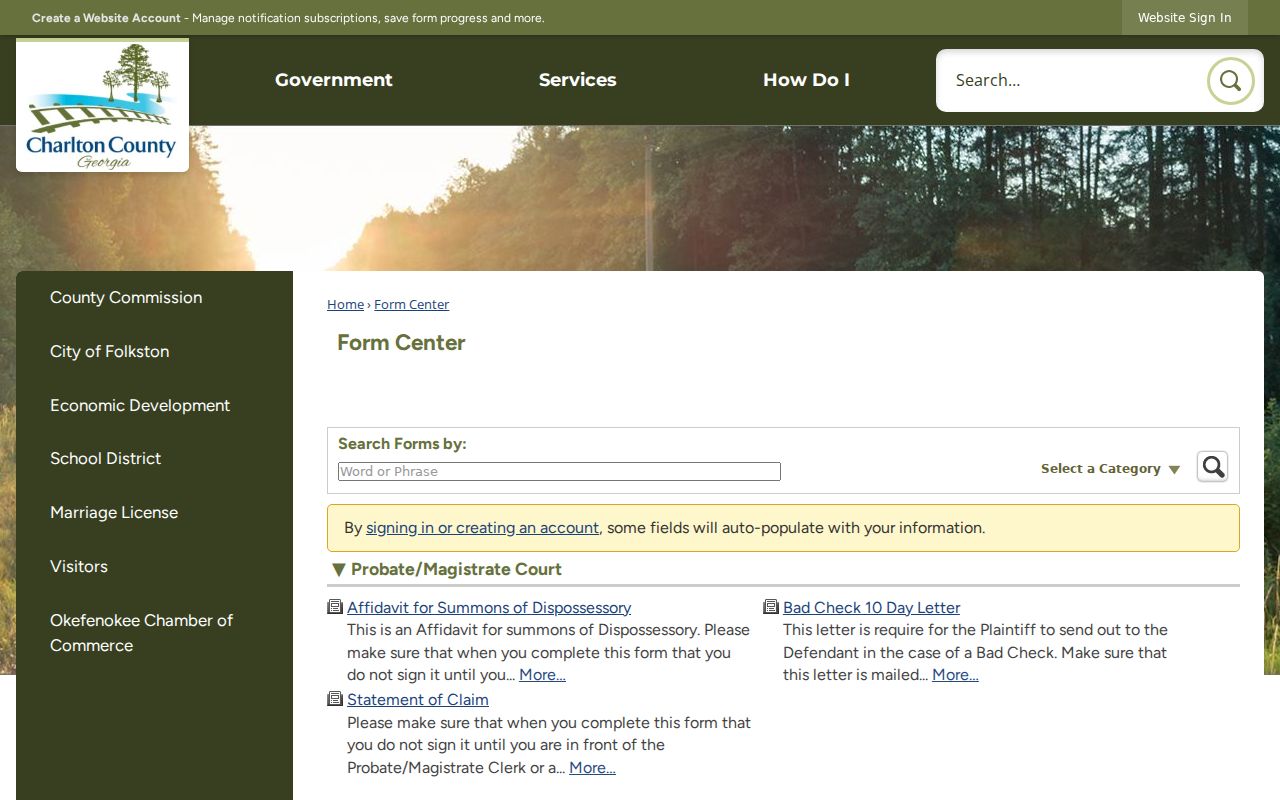
The forms list helps you name the proceeding. It is not a case search. It is useful before you call Suite B. The Magistrate Court posts no public web index for these dockets. The docket search happens at the counter or by phone.
If a case is not online, contact the clerk. Give the CI- number, the filing year, the form type, and the document you need. Ask whether the file is digital, paper, archived, restricted, or open for inspection. The schedule lists $1 copies and $10 certified copies. Always confirm whether extra pages, postage, or certification add more.
Suite B's fee schedule also lists a $110 Statement of Claim for one defendant. A dispossessory summons for one defendant is $85. Added defendants cost $25 each. Interrogatories are $60, and an extra sheriff entry of service runs $50. A Fi-Fa splits $29 between Magistrate and Superior charges. An appeal payable to Superior is listed at $205. These are published categories, not a quote. Service needs, added parties, copies, and current rules can change the total. Confirm the right category and payment method with the clerk before filing or mailing funds.
Who Can See Civil Dockets
Uniform Superior Court Rule 21 makes court records public. Law or proper procedure can still limit access. Rule 21.6 goes further when protected identifiers appear. It calls for a redacted public filing plus a separate sealing process. Sensitive case types include probate, family, and adoption. Those may carry added restrictions on the court docket.
Access rule: A public docket title does not guarantee public access to every filed image. Ask for a public redacted copy when appropriate.
The Georgia Open Records Act gives a general inspection and copy process. Records in court custody still route through the right clerk. County administration cannot simply stand in for Suite A or Suite B. A denial should name its legal basis, and a requester may ask that non-exempt portions of the court docket still be produced.